
A change in the conversation
Something interesting is happening in the way the technology industry talks about artificial intelligence. For much of the past three years, attention has been concentrated on the capabilities of individual models. We have watched increasingly sophisticated systems demonstrate extraordinary abilities in language, mathematics, programming, scientific reasoning and complex problem-solving. Each release has been accompanied by another round of benchmarks, comparisons and speculation about how much closer we might be to artificial general intelligence. It has been an astonishing period of technological progress, although the conversation has sometimes resembled an endless competition to establish which machine is currently the cleverest.
That emphasis is beginning to change. The question attracting attention is no longer simply what an AI model can do when presented with a difficult problem, but what happens when that intelligence is connected to the systems, information and processes through which an organisation conducts its business. A model that can analyse a contract is impressive; a system capable of obtaining the relevant documents, interpreting the applicable policy, resolving an ambiguity, obtaining the necessary authorisation and progressing the underlying transaction represents something rather different. The distinction is between producing an answer and performing work, and it has consequences which extend considerably beyond the technology required to make either possible.
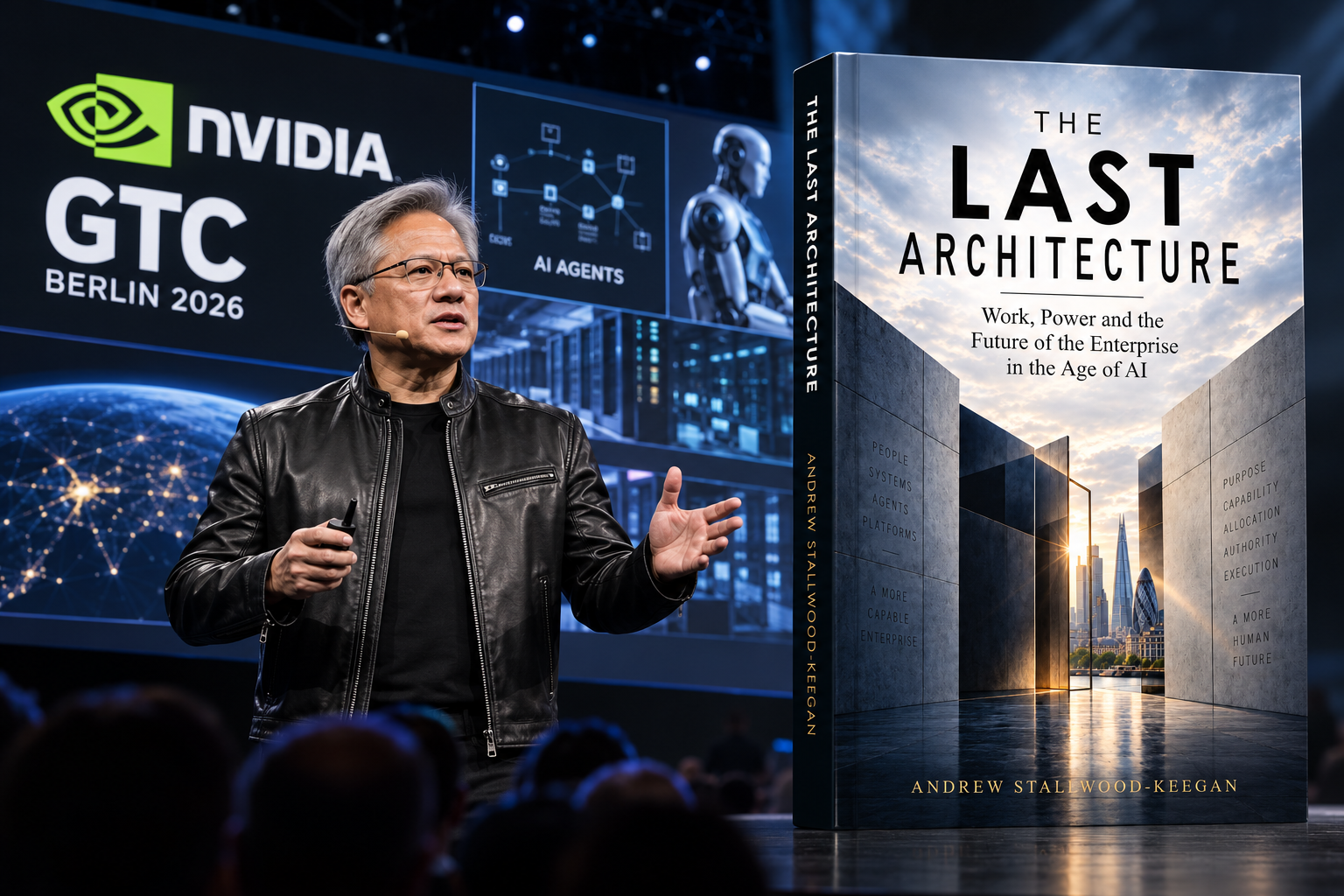
At NVIDIA's GTC Berlin conference on 21 October 2026, Jensen Huang described the emerging architecture of AI agents in terms of five principal elements: the model itself, an orchestration harness, a secure execution environment, knowledge and the tools through which the agent interacts with the world. The significance of that description lies in its recognition that intelligence alone is insufficient. The model provides reasoning capability, but it is the surrounding architecture that allows the system to maintain context, pursue an objective, interact with enterprise applications and perform useful tasks within defined boundaries.
Microsoft and Salesforce have been exploring similar territory from an organisational perspective. Microsoft's 2026 Work Trend Index argues that business leaders must reconsider the structure of work itself, rather than simply distribute increasingly capable AI tools throughout their existing organisations. Salesforce CEO Marc Benioff has described human-agent collaboration as something capable of fundamentally transforming the structure of a company. Although these businesses approach the subject from different commercial and technical positions, their thinking appears to be converging upon an important recognition: artificial intelligence is beginning to change not merely the tools available to an organisation, but the organisation of work itself.
This development is particularly interesting to us at Workforce 2040 because it closely relates to the argument explored in The Last Architecture, published earlier this year. The book proposes a different way of understanding the enterprise in an age when humans, AI agents, conventional systems and external platforms can all become legitimate performers of business work. Its central proposition is that the emergence of machine intelligence makes a longstanding weakness in enterprise architecture increasingly difficult to ignore.
The organisation we have inherited
Most large organisations continue to allocate responsibility through structures which evolved under very different technological conditions. Departments possess functions, employees occupy defined roles, applications provide particular services, and workflows direct activities between them. The resulting arrangements often have perfectly sensible origins, but they also contain decades of accumulated decisions about technology, management, control, outsourcing and organisational boundaries. What exists today is not necessarily the most appropriate arrangement for tomorrow, even if it has become so familiar that few people question why it exists.
Consider the work undertaken by an operations analyst in a large financial institution. A single job might involve gathering information from multiple systems, reconciling discrepancies, interpreting contractual terms, investigating exceptions, communicating with colleagues, exercising judgement and initiating corrective action. These activities have historically been grouped together because a suitably experienced human being could perform all of them, including the awkward work of compensating for information and systems that did not fit together particularly well. The job description became the administrative container for a collection of fundamentally different activities.
Artificial intelligence makes those distinctions increasingly important. Some of the analyst's work can be executed more reliably by conventional software. Some may be suitable for an agent capable of interpreting unstructured information and coordinating a sequence of actions. Other activities require specialist mathematical models, while certain decisions must remain subject to human authority for commercial, regulatory or institutional reasons. There may also be work which should disappear altogether because it exists merely to compensate for defects elsewhere in the organisation.
Yet the instinctive response to AI is often to begin with the existing process and identify which tasks can be automated. An agent is introduced to handle one activity, perhaps another is added to address an exception, and the workflow is modified to accommodate the new technology. These interventions may deliver considerable benefits, but they also risk preserving the assumptions embedded within the original design. The organisation has acquired more sophisticated machinery without necessarily reconsidering the logic through which work is defined and allocated.
This is not an argument against incremental automation. On the contrary, organisations should be able to adopt useful technology without undertaking a grand transformation every time a new capability becomes available. The difficulty arises when each improvement creates another relatively permanent relationship between a particular piece of work and the technology chosen to perform it. Today's innovative agent can become tomorrow's legacy application if the institution has no coherent mechanism for reconsidering that relationship as capabilities, costs and circumstances change.
From the Information Factory to the Shared Factory
The architectural problem is not entirely new. James Martin, whose work helped establish Information Engineering as a serious enterprise discipline, recognised decades ago that large organisations needed to distinguish their enduring business requirements from the physical arrangements through which those requirements happened to be implemented. Departments, applications and projects were not the enterprise itself. They were expressions of a more fundamental structure of information, functions, activities and relationships.
That distinction was central to Martin's concept of the Information Factory. Rather than beginning with an organisation chart or an inventory of applications, the enterprise could be understood through the information it processed, the decisions it made and the outcomes it was required to produce. Technology and organisational arrangements could then be designed against a more stable logical account of the business. The principle remains remarkably relevant, particularly in institutions whose systems and departmental boundaries reflect several generations of technological and managerial change.
The next development in this intellectual progression was Continuous Process Automation, which sought to connect enterprise architecture more closely to the behaviour of live operations. Traditional transformation programmes often place the authority to change an organisation inside temporary projects, while responsibility for operating the resulting processes remains with permanent teams. Continuous Process Automation challenged that separation by establishing persistent process ownership, operational evidence and a controlled mechanism through which processes could improve while continuing to operate.
Both approaches addressed important weaknesses, but neither was originally designed for a world in which general-purpose machine intelligence could perform activities previously organised around human judgement and coordination. Information Engineering separated the logical enterprise from its implementation. Continuous Process Automation made that implementation more observable and adaptable. The next question concerns the relationship between the work itself and the actor selected to perform it.
This is the foundation of the Suggested Operating Model Architecture, or SOMA, developed in The Last Architecture. SOMA proposes that the enterprise should preserve a coherent definition of its enduring capabilities while making the allocation of work among different classes of actor explicit, governed and capable of changing over time. Artificial intelligence provides the immediate reason to reconsider this relationship, but the proposed architecture is deliberately not organised around AI as a technology.
The Capability Graph: understanding what the enterprise actually does
At the centre of SOMA is the Capability Graph, a logical representation of the abilities an organisation must preserve regardless of how those abilities are currently delivered. A capability might concern establishing a customer relationship, assessing credit exposure, settling a financial transaction or resolving an operational exception. Its definition concerns the outcome required, the information and dependencies involved, the applicable constraints and the standards against which successful execution can be judged.
The distinction between a capability and a process is fundamental. A process describes a route through which something is accomplished, while a capability describes the underlying ability that the organisation needs to possess. The process may change when a new system is introduced, when responsibility moves between teams or when an external provider assumes part of the work. The capability remains recognisable because its purpose and required outcome have not necessarily changed.
A capability graph also makes relationships visible which conventional organisational structures frequently conceal. One capability may depend upon information produced by another, invoke specialist services elsewhere in the enterprise or rely upon a shared platform used by several business functions. A change in one area may therefore produce consequences in another which would be difficult to identify from an organisation chart or individual workflow. Representing these relationships explicitly allows the institution to reason about dependencies, resilience, accountability and change without assuming that the existing administrative boundaries are the natural boundaries of the business.
It is worth distinguishing this idea from the graphs increasingly discussed in the AI industry. An agent execution graph describes the progression of tasks, tools and decisions involved in completing a particular workflow. A knowledge graph represents relationships between information objects and concepts. SOMA's Capability Graph operates at a different level, describing the enduring business abilities within which those technical mechanisms must function. All three may be necessary, but they answer different questions and should not be confused merely because they share a mathematical form.
The practical value is that the organisation acquires a relatively stable reference point against which changing forms of execution can be evaluated. If a new agent becomes capable of performing work previously undertaken by an employee, the capability does not need to be redefined around the agent. If an external platform offers a better service, it can be considered against the same business requirement. The organisation retains its understanding of what must be accomplished without granting the current technology permanent ownership of the work.
The Work Allocator: separating work from its performer
Understanding the enterprise through capabilities is only the first part of the architecture. Once work has been defined independently of its current implementation, another question becomes possible: who, or what, is the most appropriate performer for a particular item of work under the conditions applying at that moment?
SOMA introduces a logical function called the Work Allocator to make that decision explicit. The Allocator considers the nature of the work, the competence and availability of potential actors, applicable policies, delegated authority, economic considerations and the consequences of failure. Its candidates may include human specialists, AI agents, conventional software, specialist models, external service providers or combinations of several performers working together.
Consider a familiar post-trade exception in investment banking. A discrepancy may arise between information held by two systems, preventing a transaction from progressing towards settlement. For a recurring and well-understood class of exception, an agent might be capable of assembling the relevant evidence, identifying the likely cause and preparing a proposed correction. A deterministic service could subsequently execute an authorised action, while a human specialist would become involved where the discrepancy required interpretation of commercial intent or a decision outside the agent's delegated authority.
The architecture does not assume that one actor must complete every stage of the work. Nor does it assume that the division between human and machine execution should remain constant. The appropriate arrangement may vary according to the complexity of the case, the information available, the current competence of the actor and the institutional authority required. A machine might become suitable for a broader class of work after demonstrating reliable performance, or have its scope restricted following an incident or deterioration in quality.
This is where the distinction between agent orchestration and enterprise architecture becomes particularly significant. An orchestration framework may determine how an agent proceeds through a sequence of tasks, when to invoke a tool or how to recover from a failed operation. SOMA addresses the decision that precedes and surrounds that execution: whether the agent should have received the work, which contributions it is legitimately permitted to make and what evidence must exist for the institution to remain accountable.
The Work Allocator is not intended to be a vast central intelligence distributing every task across the enterprise. In many circumstances, a transparent routing rule or an existing workflow system may provide everything required. More sophisticated allocation becomes useful where variations in work, actor capability, capacity or risk make the decision genuinely more complicated. The architectural innovation lies in making allocation a deliberate and revisable operating-model function, not in introducing unnecessary technological sophistication.
Intelligence does not confer authority
One of the most encouraging aspects of the recent discussion around agent architecture is the growing recognition that intelligence and legitimate authority are different things. An AI system may possess the technical ability to perform an action without having any business justification for doing so. The fact that an agent can retrieve sensitive information, modify a customer record or initiate a financial transaction does not establish that the organisation should grant it those powers.
This distinction has always existed in human organisations, although much of it has been managed through roles, procedures, access rights and professional judgement. Experienced employees generally understand that certain actions require particular authority, that some matters must be escalated and that permission to access information does not necessarily include permission to act upon it. The arrangement is far from perfect, but people have historically supplied much of the interpretation needed to connect written policy with operational reality.
Agentic systems make this informal dependence increasingly difficult to sustain. An agent capable of independently pursuing an objective requires an identifiable role, defined permissions, limits upon delegated authority and mechanisms through which its actions can be attributed and, where necessary, stopped. It is not sufficient to place a natural-language instruction inside the agent's configuration asking it to behave responsibly. Important restrictions must be enforceable by the systems through which the agent operates.
NVIDIA's emphasis on secure execution environments and Salesforce's work on an Enterprise AI Harness address significant technical elements of this problem. Such developments will become increasingly important as organisations move from isolated demonstrations towards productive agents interacting with consequential business systems. However, technical safeguards cannot independently determine which institutional powers should be delegated, which outcomes require human judgement or how responsibility should be distributed when several actors contribute to a result.
SOMA approaches these questions through a separation of competence, policy, identity and authority. The architecture must know what an actor is capable of doing, what it is permitted to do, on whose authority it acts and which constraints apply to the particular work involved. Those distinctions should remain visible as work moves between people, agents, systems and external providers, particularly where an action changes the state of the business or creates consequences that cannot easily be reversed.
The importance of evidence and continuous correction
There is a further complication in allowing intelligent systems to perform enterprise work. An organisation may know that an agent completed a task successfully without understanding whether it should have received that task, whether the correct information was used or whether the apparent success concealed additional work elsewhere. A model can produce an elegant explanation for a decision, but the explanation is not necessarily a reliable account of the sequence of events that produced it.
SOMA therefore treats observability as an operating requirement rather than a technical monitoring exercise added after deployment. For consequential work, the institution should be able to reconstruct the item received, its classification, the allocation decision, the participating actors, the permissions and policies in force, the material actions performed and the eventual outcome. The level of detail should be proportionate to the consequence, but the evidence must be sufficient for the organisation to understand and challenge what occurred.
That record also creates the basis for continuous improvement. If an agent consistently resolves a particular class of work more effectively than the existing arrangement, the evidence may support an adjustment to future allocation. If its performance deteriorates, its permitted scope can be reduced. Where repeated intervention reveals a weakness in an upstream information source or business process, the appropriate response may be to correct the underlying capability rather than endlessly refine the automation used to repair its consequences.
This is an important extension of the feedback principles developed through Continuous Process Automation. The enterprise is no longer merely observing and improving an established process. It is also observing the relative performance of different actors and reconsidering the allocation of work between them. The result should be an operating model capable of learning from production experience without allowing an optimiser or agent to rewrite the institutional policies under which it has been authorised to operate.
The economic and organisational consequences
The economic possibilities are considerable, but they deserve more careful treatment than the familiar comparison between the cost of employing a person and the price of invoking an AI model. A human employee carries visible employment and management costs, while the marginal cost of machine execution can appear remarkably low. Yet productive agents also require engineering, integration, computing infrastructure, evaluation, security, monitoring, supervision and some means of recovering when things go wrong. Poorly designed automation can move costs around an organisation without reducing them.
An agent may appear exceptionally productive because it receives routine cases while experienced employees retain only the most complex exceptions. An external platform may offer attractive unit economics while increasing dependency upon one provider. A conventional software service may be cheaper and more reliable than an agent for work whose logic is already well understood. The economically sensible decision therefore depends upon the complete execution pattern and the outcome it produces, not simply the apparent price of the most visible performer.
The workforce implications are similarly complex. As machine systems absorb more routine execution, the work remaining with people may involve greater uncertainty, responsibility and judgement. Some managerial functions concerned primarily with collecting and redistributing information may become less necessary, while others concerned with developing expertise, governing capabilities and exercising accountable authority become more important. These are not automatic consequences of technological progress, but choices that organisations will make through their operating models.
There is also a difficult question about how expertise is formed. Many experienced professionals acquired their judgement through years of handling relatively ordinary work before progressing towards unusual or consequential cases. If machines absorb that routine experience, organisations may preserve today's senior specialists while weakening the route through which tomorrow's experts are developed. Human oversight cannot remain credible indefinitely if the people expected to exercise it lose the practical knowledge required to recognise when a machine is wrong.
An adaptable enterprise must therefore consider the preservation of human competence, credible fallback arrangements and professional development alongside the immediate benefits of automation. In some circumstances, retaining human execution will be a deliberate investment in resilience rather than evidence that the technology has failed. The objective should be an appropriate and sustainable distribution of work, not an ideological pursuit of the highest possible automation percentage.
From agent deployment to enterprise transformation
Microsoft's 2026 Work Trend Index offers an interesting perspective on the scale of the challenge. Its research identifies organisational conditions, including leadership, culture and working practices, as important factors in whether businesses obtain meaningful value from artificial intelligence. The report also describes rapidly expanding use of agents within the Microsoft ecosystem, suggesting that the supply of machine capability is increasing much faster than the institutional structures required to manage it have traditionally evolved.
This imbalance is likely to become more visible as agent-building tools improve. It may become progressively easier to construct a system capable of undertaking a useful business activity, while determining the boundaries of that activity, connecting it to authoritative information, securing legitimate permissions and ensuring accountability remain demanding exercises. The technology may be deployed in weeks while the organisation continues to carry assumptions that have accumulated over decades.
There is a temptation to respond by launching another comprehensive enterprise transformation programme, complete with a new target operating model and the promise that every business function will eventually conform to it. That approach risks reproducing the same problems which have made enterprise transformation so difficult historically. A complex organisation cannot suspend its operation while its future is designed, and a highly detailed model of the intended destination may become outdated before the institution reaches it.
A more practical approach begins with a consequential but bounded business capability. The organisation establishes what outcome is required, identifies the work classes involved, maps the important dependencies and determines which actors currently perform the work. Existing allocation choices are then made explicit, including the policies and authority which explain them. A new agent can enter this arrangement through a carefully defined role, with its performance observed against the existing capability rather than judged solely by the success of the technical deployment.
As evidence accumulates, the organisation gains the ability to change the execution mix deliberately. Successful approaches can be extended into neighbouring capabilities, while common patterns for identity, policy, evaluation and observability emerge through repeated practical use. The intention is not to finish implementing a universal architecture, but to establish a permanent capability for adapting the enterprise without constantly recreating the machinery of transformation.
The next competitive advantage may be architectural
The developments described by NVIDIA, Microsoft and Salesforce do not establish that a particular enterprise architecture has become inevitable. Their technical approaches differ, and the industry is still discovering which forms of agent orchestration, memory, control and organisational integration will prove reliable at scale. Some capabilities that appear impressive in demonstrations will struggle against the complexity of actual institutions, while others will become commonplace more quickly than anyone anticipated.
Nevertheless, the direction of travel is becoming clearer. Intelligence is moving beyond the production of isolated answers and towards participation in the execution of work. As that happens, organisations will face increasingly difficult decisions about how capabilities should be defined, how work should be allocated, which actors should possess authority and how accountability can survive a constantly changing mixture of human and machine execution.
At Workforce 2040, we believe these questions belong at the centre of enterprise AI transformation. The most successful organisations will not necessarily be those deploying the greatest number of agents or purchasing the most sophisticated orchestration platforms. They will be those capable of understanding their business independently of the technology currently supporting it, introducing new forms of intelligence where they genuinely improve outcomes, and changing those arrangements as circumstances evolve.
This will require technical expertise, but technology alone will not be sufficient. Enterprise architects, domain specialists, operational leaders, risk professionals and AI practitioners will need to work within a more coherent understanding of business capability and execution. The organisations that develop these disciplines early may find themselves able to absorb successive generations of intelligence with considerably less disruption than competitors still attaching each new technology to an inherited process.
The wider significance of SOMA lies in its attempt to make that adaptability an enduring property of the enterprise. It does not seek to predict the final division of labour between people and machines, nor does it assume that ever greater autonomy will always be desirable. Instead, it proposes an architecture in which the purpose of the organisation remains stable enough to be understood and governed while the actors performing its work can change.
As the technology industry concentrates increasingly on the machinery required to make intelligent agents productive, the enterprise must address the structure within which that productivity becomes meaningful. We are entering a period in which intelligence itself may become abundant, but the capacity to organise it coherently, exercise judgement over its use and remain accountable for its consequences will remain a source of genuine competitive advantage.
That is the architectural challenge at the heart of The Last Architecture, and one we believe will increasingly define the next stage of enterprise transformation.
About Workforce 2040
Workforce 2040 is focused on the practical implementation of enterprise artificial intelligence and the development of the specialist capabilities organisations will require as intelligent systems become integral to business operations. Our approach combines enterprise architecture, AI transformation and the recruitment, training and deployment of professionals capable of turning emerging technologies into sustainable operational improvements.
The Last Architecture: Work, Power and the Future of the Enterprise in the Age of AI explores the Suggested Operating Model Architecture (SOMA), its Capability Graph, Work Allocator and governance principles, and the implications of variable human and machine execution for the future enterprise.
Sources and further reading
NVIDIA: Jensen Huang's GTC Berlin 2026 keynote, 21 October 2026, covering agent architecture, enterprise infrastructure and the role of secure execution environments.
Microsoft: 2026 Work Trend Index, examining AI agents, the redesign of work and organisational readiness.
Salesforce: How Salesforce Is Reimagining Its Workforce for the Agentic Enterprise and Introducing the Trusted Enterprise AI Harness, exploring human-agent collaboration and the infrastructure supporting governed enterprise AI.
Andrew Stallwood-Keegan: The Last Architecture: Work, Power and the Future of the Enterprise in the Age of AI (Workforce 2040, 2026). ISBN 978-1-0669699-0-6.